Ask five studios how much a website costs and you’ll get five completely different answers. One might quote £2,500. Another might quote £25,000. Both can be reasonable, because the word website describes almost anything from a polished template to a complex digital platform.
For businesses in Bath and the wider South West, the useful question isn’t how much a website costs. It’s what you need the website to do, how long it needs to last, and how much responsibility you want the studio to take for getting it right.
This isn’t a rate card. It’s a practical explanation of what tends to change as website budgets grow, and where a studio like ours fits depending on the scope and stage of the business.
The broad cost ranges
At the lower end, a freelancer or small supplier will adapt an existing theme for somewhere between £1,500 and £4,000. That can be entirely appropriate for a new business that needs a credible online presence quickly and has straightforward content. The trade-off is usually less strategy, less original design, and a site constrained by the template underneath it.
Between roughly £4,000 and £10,000, you should expect a more considered small business website. There may be custom design across the key pages, a clearer structure, and a sensible content management system. The scope will usually be focused, so it’s worth asking what is actually bespoke and what is being adapted from an existing system.
From around £10,000 to £25,000, the project should become much more joined up. Strategy, information architecture, content shaping, visual design, development, accessibility, performance, CMS design, and launch support are all treated as parts of the same job. Our projects tend to sit across this range, from focused custom websites to broader work that connects the site with the brand and the way the business markets itself.
Beyond £25,000, the complexity is usually not just visual. Multilingual content, complex integrations, large content libraries, e-commerce, user accounts, data-driven tools, or significant brand work can all move a project into a larger budget. If branding is the bigger part of the brief, we have written a separate guide to how much branding costs.
What actually drives the price
How much thinking is needed before design. A website for a ten-person consultancy with a clear offer is a different problem from a website for a company with several services, audiences, and internal stakeholders. The more ambiguity there is around positioning, content, and structure, the more strategic thinking the project needs before anyone opens Figma.
How original the design needs to be. There’s nothing automatically wrong with a template, but it limits how closely the website can reflect the character of the brand. A custom site takes longer because decisions are being made specifically for the business rather than inherited from somebody else’s layout.
How the site is built. A simple brochure site can be developed quickly. A flexible content system that lets an internal team build new landing pages, case studies, and campaigns without breaking the design takes more care. The quality of the CMS is often where the value of a serious build becomes clearest six months after launch.
Content, photography, and motion. A beautifully designed website will still feel weak if the copy is vague and the images are generic. Content direction, copywriting, photography, illustration, 3D, and motion each add cost, but they are often the things that make the website feel unmistakably yours.
Accessibility and performance. These are not optional extras. They affect who can use the site, how it performs in search, and how credible the business feels. A low quote sometimes looks low because testing, optimisation, and quality assurance are barely included. We’ve written more about both in our guide to what to expect from a serious web design studio.
What’s usually missing from the cheapest quote
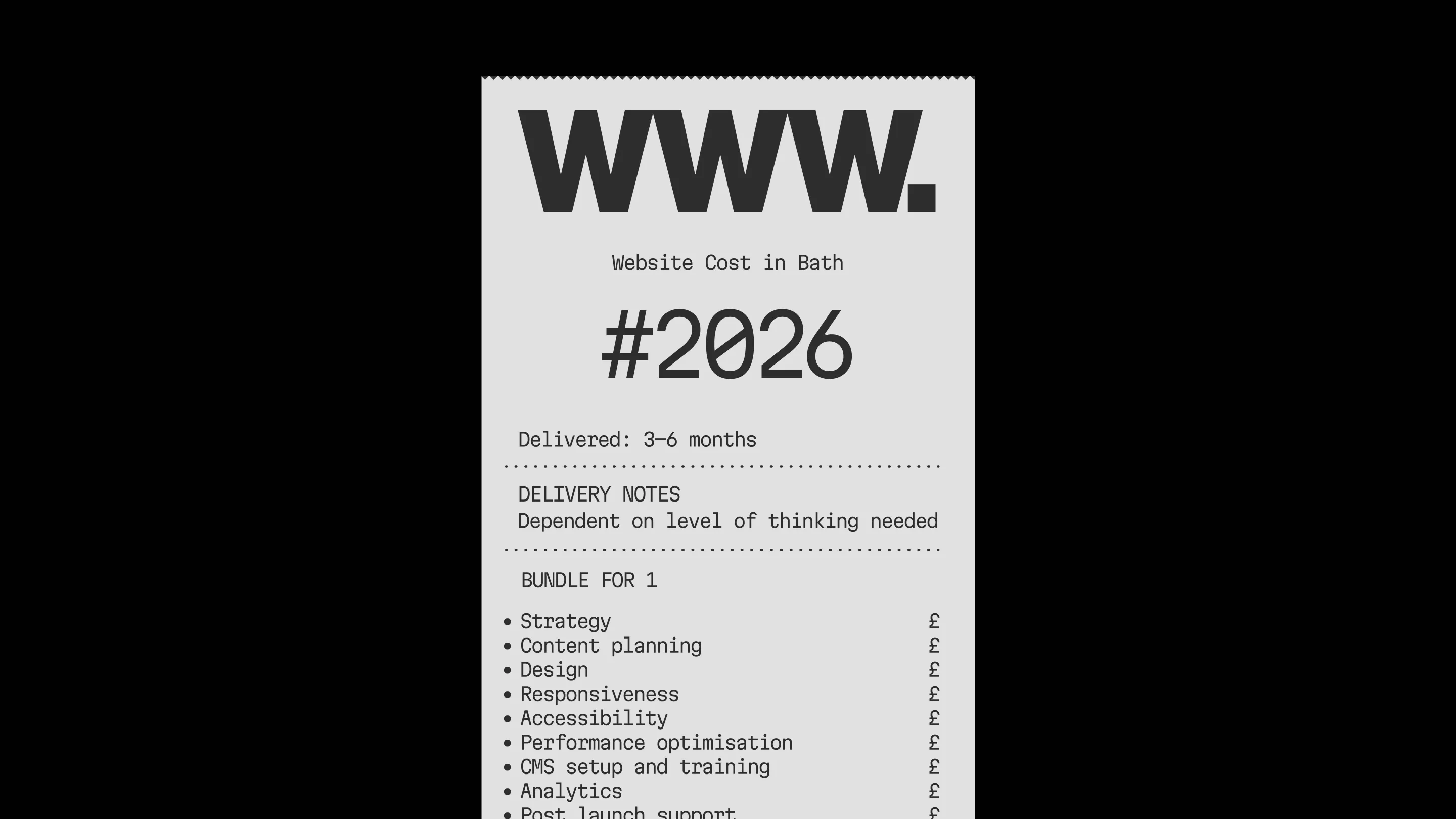
The cheapest quote isn’t always poor value. It may simply describe a much smaller job. Before comparing proposals, check whether they include:
- Strategy and information architecture
- Content planning or copy support
- Original design across all key page types
- Responsive behaviour, not just desktop layouts
- Accessibility and browser testing
- Performance optimisation
- CMS setup and editor training
- Analytics, redirects, and launch support
- A post-launch period for fixes and refinement
Two proposals can use the same phrase, website design and build, while containing very different amounts of work.
Where we fit
Bodkin is a small, senior design agency near Bath working across brand identity, websites, and digital products. We’re usually brought in when a business wants more thought and originality than a standard template build, whether that means a focused custom website or a larger project connecting the site with the brand, content, and wider customer experience.
We design and build as one team, which means the thinking isn’t lost between a design studio and a separate development supplier. The people discussing the brief are the people shaping the structure, designing the pages, and making decisions about how the finished site should work.
That won’t be the right route for every business. Where the brief is straightforward, we keep the scope focused. Where the website needs to carry more strategic or technical weight, we build the project in phases rather than pretending everything has to happen at once.
A better question to ask
Rather than asking a studio, “How much does a website cost?”, ask, “What would you need to solve for this website to be worth the investment?”
The answer will tell you far more about the quality of the work, the level of thinking involved, and whether the studio is trying to sell you a set of pages or build something useful.
If you are planning a new website in Bath, Bristol, or the wider South West, tell us what is currently not working and what you are comfortable investing. We’ll be honest about what we’d prioritise, what could wait, and whether a simpler route would do the job.